
App Guides
Shared Journal Apps for Couples: A Slower Way to Stay Close
Inside CloserTo
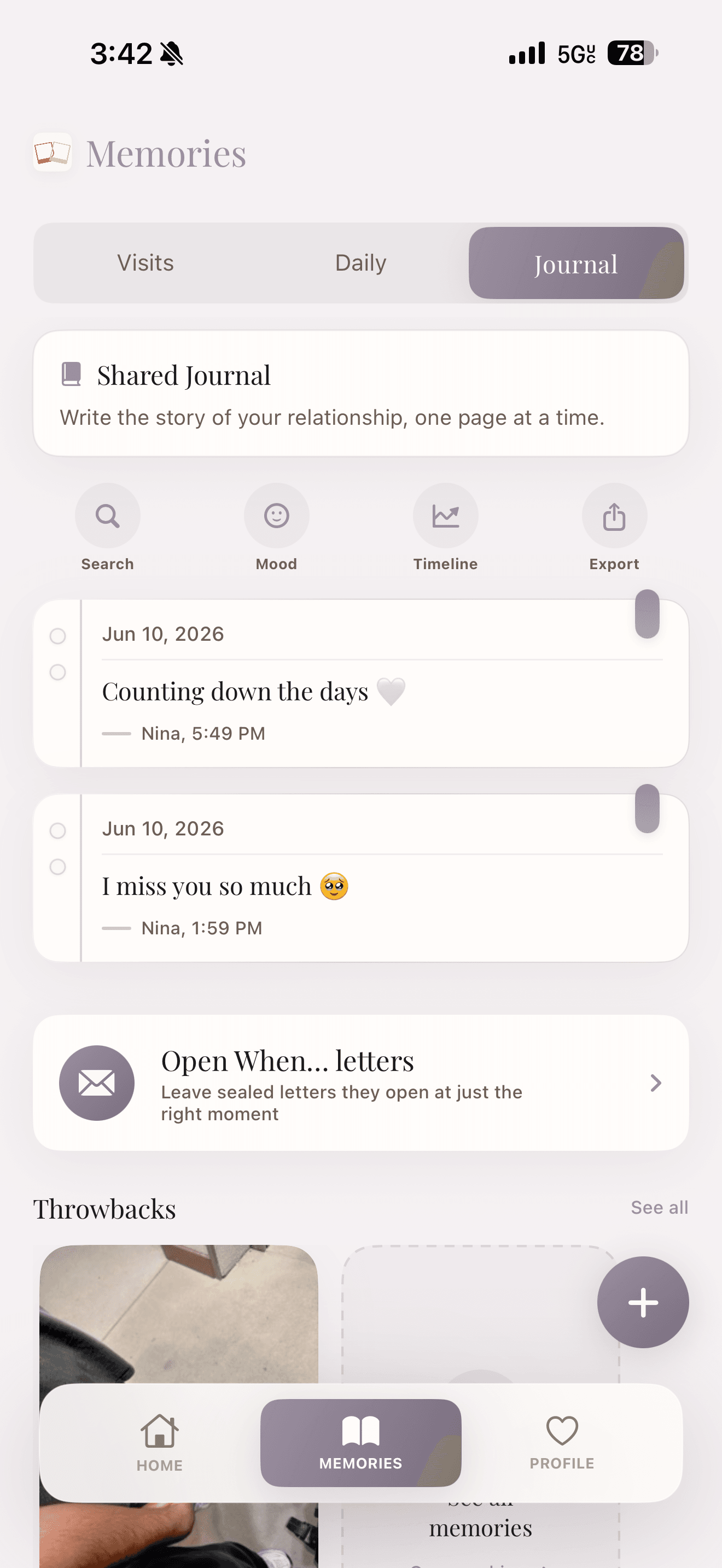
The shared journal gives long-distance couples a slower place for the feelings that do not fit in a text.
Texting is where long-distance relationships live — and texting is also where everything disappears. The sweet thing they said in March is forty thousand messages up. The night you talked until 3 a.m. is buried under a week of “omw” and grocery lists. The chat scrolls, and almost nothing sticks.
A shared journal is a different kind of channel. Slower, quieter, and built to be kept. You write a few lines when something is worth keeping, your partner does the same, and over months it becomes the thing no chat history will ever be: a record of the relationship, written by the two people living it.
Why journaling together keeps long-distance couples close
It’s a slower channel than texting
Chat is a tennis match — fast, reactive, half-attention. A journal has no read receipts and no expected reply time, and that changes what gets written. You’re not answering; you’re telling. Even three sentences written in that mode carry more of you than an hour of rapid-fire messages, because nobody writes “I’ve been thinking about us a lot this week” between two typing bubbles.
You’ll write things you’d never say in chat
There’s a category of thought that’s too soft for text and too small for a phone call: the flash of pride watching them handle something hard, the worry you talked yourself out of, the ordinary Tuesday when you missed them more than made sense. In chat, those thoughts feel like too much. On a journal page, they’re exactly the right size. It works the same way good questions unlock better calls — change the container, and deeper things come out.
It becomes a record you can reread
This is the part that pays off months later. On a doubtful day — and long distance hands everyone doubtful days — you can open the journal and see the evidence: their entry from the night before your last reunion, your entry from the morning after, the little moods stacked up across a hard month you got through anyway. A chat history is a transcript. A journal is proof.
What makes a good shared journal app for couples
Plenty of apps have a notes feature. A journal that two people will still be writing in six months needs a few specific things:
- Private to exactly two people. Not a social feed, not a family space. The whole point is saying things you’d only say to each other.
- Low-pressure by design. If every entry has to be an essay, the journal dies in week two. Moods, one-liners, and quick notes need to count.
- One shared timeline, two voices. Entries from both of you should interleave into a single story, not sit in separate his-and-hers diaries.
- It lives next to your other memories. A journal in its own silo gets forgotten. One that sits beside your photos, visits, and countdown gets opened.
- Free to start. You shouldn’t have to pay to find out whether the habit sticks.
Journal prompts for couples: 16 to steal
The blank page is the number one killer of couple journals. Don’t face it — steal a prompt instead.
Everyday prompts
- The favorite part of my day, in two sentences.
- A small thing that made me think of you today.
- Something I ate that you would have stolen a bite of.
- Today’s mood, in three words.
- A song that matched today, and why.
- The most boring thing I did today — told as dramatically as possible.
Deeper prompts
- A thing I didn’t tell you this week (and why I’m telling you now).
- Something I’m nervous about that I’ve been keeping small.
- What I’m most looking forward to when we finally close the distance.
- A moment recently when I felt really loved by you.
- Something I want us to get better at — gently.
Milestone entries
- The day we said goodbye after a visit — written while it still stings, because that’s when it’s true.
- The night before a reunion: what I’m feeling at the airport gate of my brain.
- Monthiversaries: one paragraph on where we are, so future-us can watch it change.
- After a hard conversation: what I understood better afterward.
- The very first entry: how we met, in your own words — you’ll be amazed how differently you each tell it.
How the Shared Journal works in CloserTo
CloserTo’s Shared Journal is built around one idea: write the story of your relationship, one page at a time. Either of you can add a reflection, a mood, or a quick note whenever the moment strikes — there’s no schedule, no streak pressure, no required format. A mood emoji on a flat Tuesday is a legitimate entry. So is three paragraphs at midnight before a reunion.
Entries from both of you interleave into a single timeline, so reading it back feels like one story told in two voices — your Tuesday next to their Tuesday, your goodbye entry answered by theirs. Everything is archived in Memories → Journal, right beside your daily photos and visit films, and Throwbacks resurface old entries when you least expect them. Getting ambushed by your own entry from eight months ago — written on a day you thought you couldn’t do this — is a very specific kind of medicine.
Make it a ritual, not a chore
The couples who keep a journal going aren’t more disciplined than you. They just made it smaller and attached it to something they already do.
- Anchor it to an existing ritual. If you already swap a daily photo, write your line right after the reveal. The photo says what today looked like; the entry says what it felt like.
- Set the bar embarrassingly low. Two sentences is a real entry. A mood is a real entry. The bar is “I showed up,” not “I wrote something beautiful.”
- Don’t keep score. If they wrote four entries this week and you wrote one, nothing is wrong. A journal with turn-taking rules becomes homework.
- Book-end your visits. One entry the night before a reunion, one after the goodbye. If you only ever write those two, you’ll still build something worth rereading.
- Reread together sometimes. On a call, open an old month and read it out loud. It’s the cheapest, warmest date you’ll ever have.
Rituals like this are half of what makes distance survivable — the small repeated things that make a relationship feel lived in rather than waited out. (Our guide on how to make a long-distance relationship work goes deep on the rest.)
Here’s the quiet promise of a shared journal: one day the distance will be over, and the chat logs will be a blur. But there will be this book the two of you wrote without meaning to — the moods, the Tuesdays, the goodbyes, the countdowns — and it will read exactly like what it is. Not a diary. A love story, told in two voices, one page at a time.
Frequently asked questions
- What is the best shared journal app for couples?
- The best couples journal app is the one you’ll both actually open: private to exactly two people, low-pressure enough that a mood or a single sentence counts, and kept in one shared timeline rather than two separate diaries. For long-distance couples specifically, CloserTo’s Shared Journal is a strong fit because both partners’ entries interleave into one running story, and the journal lives right next to your daily photos, countdown, and visit memories instead of in a separate app.
- Is there a free couples journal app?
- Yes. CloserTo’s Shared Journal is part of the free tier on iOS, along with the daily photo exchange, countdown, and Open When letters. CloserTo+ adds an extended journal and other perks, and only one partner needs to subscribe for both of you to get everything.
- Can both partners write in the same journal?
- In CloserTo, yes — that’s the whole design. You each write reflections, moods, or quick notes whenever you like, and the entries from both of you interleave into a single shared timeline in Memories → Journal. Reading it back feels like one story told in two voices rather than two parallel diaries.
- What should we write about in a couples journal?
- Anything, and less than you think. A mood, a one-line “favorite part of today,” a song, a thing you didn’t say on the call. Add longer milestone entries after visits, before reunions, or on anniversaries. Prompts help enormously at the start — the habit matters far more than the word count.
Keep reading
App Guides
Open When Letters: 25+ Ideas for Long-Distance Couples
Open when letters let you comfort your partner at the exact moment they need it, even when you’re asleep three time zones away. Here’s what to write and when.
App Guides
The Long-Distance Countdown: Why Counting Down to Your Next Visit Works
A countdown gives every goodbye an expiry date. Here’s the psychology behind why it helps, and how to put your reunion countdown right on your lock screen.
App Guides
The Distance Between Us Widget: Put the Miles on Your Lock Screen
The TikTok-famous distance widget, explained: why seeing the miles between you matters, what you need on iPhone, and how to set it up in a couple of minutes.