
Long-Distance Tips
How to Survive a Long-Distance Relationship: A Real Survival Guide
Inside CloserTo
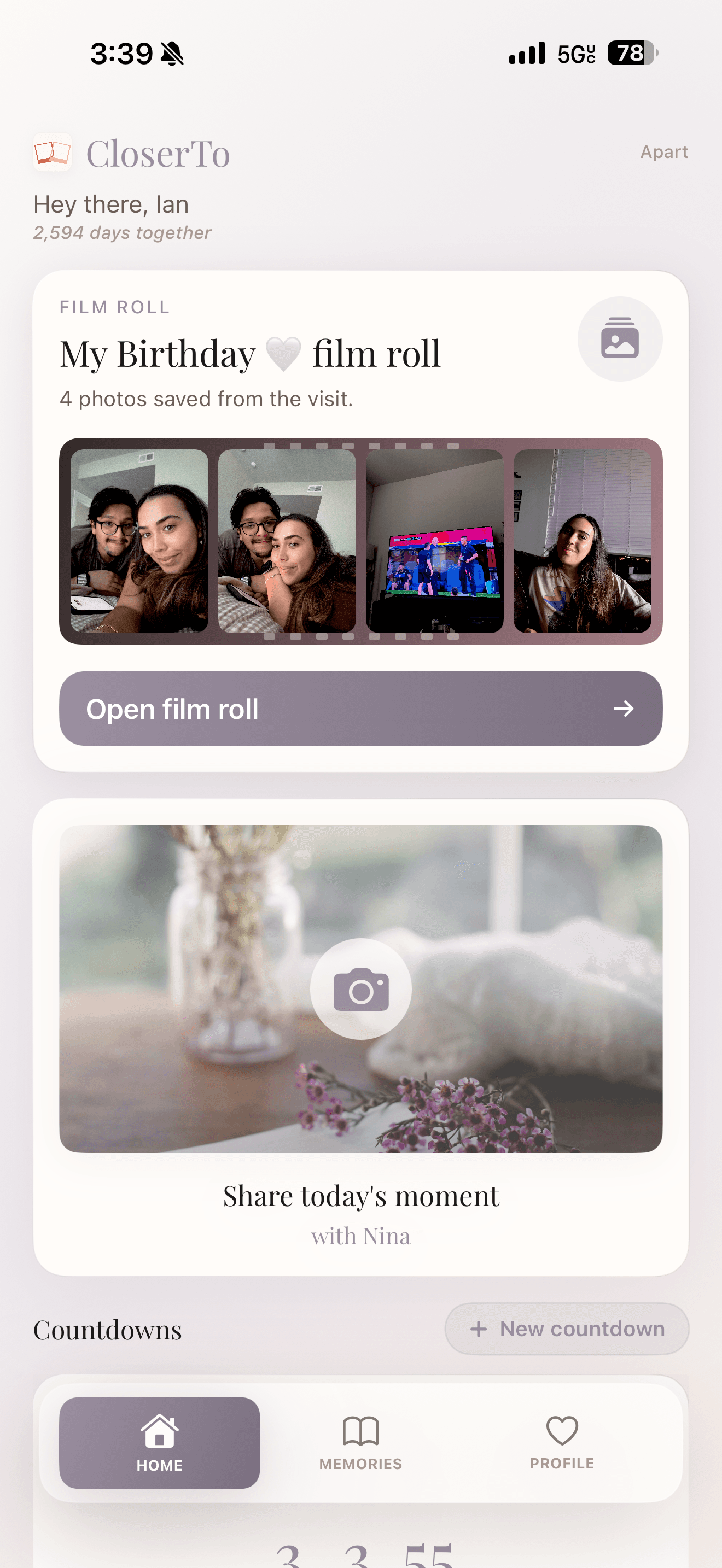
A steady home base makes long distance feel less scattered: countdown, photos, letters, and memories together.
Nobody tells you that the hardest part of long distance isn’t the airport goodbyes or the time zones. It’s the ordinary Tuesday when nothing is wrong, you just miss them so much it sits in your chest like a stone. If that’s where you are right now, take a breath. You’re not failing. You’re doing one of the hardest things two people who love each other can do.
Here’s the truth that the sad TikToks won’t tell you: long distance is survivable, and plenty of couples come out the other side closer than the ones who were never tested. Surviving it isn’t about white-knuckling through the lonely days. It’s about building a relationship that actually works across the gap, with rhythms and rituals and a plan, so the distance becomes a chapter instead of the whole story.
Name the hard parts instead of pretending they don’t exist
The first survival skill is honesty about how hard this actually is. Couples who pretend they’re fine, who swallow the lonely nights and the flicker of jealousy when their partner posts a story from a party, tend to crack quietly. The ones who say it out loud, who text “I’m having a low day and I just miss your face,” are the ones who make it.
You will have hard days. You’ll feel out of sync, you’ll get insecure for no reason, you’ll resent a friend who gets to see their partner every weekend. None of that means your relationship is broken. It means you’re human and you love someone who isn’t close enough to hug. If you want the bigger framework for the whole thing, our guide on how to make a long-distance relationship work goes deeper on the foundations.
Find your communication rhythm (it’s not constant texting)
The biggest myth in long distance is that more communication equals a stronger relationship. It doesn’t. Texting every second of every day usually leads to two things: you run out of things to say, and you start narrating logistics instead of actually connecting. The couples who thrive find a rhythm that fits both of their lives.
Quality over volume
A five-minute call where you’re both fully present beats three hours of half-distracted texting while you scroll. Protect a little pocket of real, undistracted time, even if it’s short. Put the phone close to your face, not next to the TV.
- Pick a loose daily rhythm: maybe a good-morning text, a couple of voice notes through the day, and one proper call or video date.
- Voice notes are underrated. Hearing their voice mid-sentence, laughing, half-asleep, lands so much warmer than typed words.
- Have a standing video date you both protect, the way you’d protect plans with a friend you adore.
- It’s okay to go quiet sometimes. Silence isn’t distance. You don’t owe each other a running commentary.
When the conversation does run dry, that’s normal too, not a warning sign. Keep a few real prompts in your back pocket. Our list of questions to ask in a long-distance relationship is built for exactly those “what do we even talk about tonight” moments.
Survive the time zones without resenting them
If you’re separated by a few hours, you already know the math: their morning is your afternoon, their bedtime is your lunch, and finding overlap can feel like a part-time job. The trick is to stop fighting the time difference and start working with it.
- Map your real overlap. Find the window where you’re both reasonably awake and free, and treat it as sacred.
- Take turns sacrificing. One of you stays up late, the other wakes early, and you trade off so the same person isn’t always exhausted.
- Lean on async love. A goodnight voice note they wake up to, a photo waiting on their lock screen, a journal entry they read at breakfast. Connection doesn’t have to happen live to count.
- Make peace with the gap. When you can’t talk, send something instead of nothing. A heart, a song, a “thinking of you” keeps the thread warm.
Build trust so jealousy doesn’t run the show
Distance is fertile ground for the anxious brain. You can’t see who they’re with, your imagination fills the silence, and one unanswered text can spiral into a three-hour story you wrote yourself. Surviving long distance means refusing to let that story drive.
Trust isn’t built by checking their location or interrogating their nights out. It’s built by transparency and reliability, the small promises kept over and over. They say they’ll call after work, and they do. You mention something that worried you, and they actually listen instead of getting defensive.
Jealousy is usually fear wearing a costume. Name the fear underneath, say it gently, and most of the time it loses its grip.
When insecurity flares, lead with how you feel instead of an accusation. “I felt a little anxious when I didn’t hear from you all night” opens a door. “Who were you with and why didn’t you text me” slams one. And give them, and yourself, the benefit of a full life. A partner with their own friends, hobbies, and Saturday plans is a partner who isn’t putting the impossible weight of their whole happiness on a person hundreds of miles away.
Keep intimacy alive across the gap
Intimacy isn’t only physical, and the emotional kind is the part you can absolutely keep alive from a distance. It’s the inside jokes, the being known, the feeling that someone is paying attention to the small, unglamorous details of your day.
- Share the mundane, not just the highlights. The sandwich you ate, the annoying coworker, the dog you saw on your walk. Ordinary updates are what make you feel like part of each other’s actual lives.
- Be a little flirty. Distance is no reason to let the spark go quiet. A “wish you were here right now” still works.
- Do things side by side, even apart. Watch a show in sync, play a game, cook the same recipe on a call. Our long-distance relationship activities and date ideas lists are full of ways to feel together while you’re apart.
- Send something they can hold onto. A daily photo, a voice note, a silly selfie. Tiny tokens that say “you were on my mind.”
Have an end goal: the plan to close the distance
This is the one that matters most. Couples don’t usually break under distance itself. They break under indefinite distance, the kind with no light at the end. A relationship can survive a lot when you both know it’s temporary and you’re working toward the same finish line.
You don’t need an exact date carved in stone. You need a shared direction and a rough sense of when. Who’s moving, and when? What has to happen first, the degree, the lease, the job, the savings? Talk about it openly and revisit it as life shifts. A visible countdown to your next visit, and to the bigger goal of finally being in the same place, turns vague waiting into something you’re actively building toward. (For the reassuring data on couples who go the distance, our long-distance relationship statistics piece is worth a read on a doubtful day.)
Survive the hard days and make reunions count
On the days it feels too heavy
Some days you’ll just ache, and no amount of advice fixes that. On those days, be gentle with yourself. Reach for the comfort of an old photo, reread the sweet messages, look at the countdown. Let yourself feel it without deciding it means the relationship is doomed. The goodbye after a visit is its own special kind of awful; if you’re in that fog right now, coping after saying goodbye is written for exactly that ride home.
When you’re finally together
Reunions carry so much pressure to be perfect that they can buckle under it. Take the pressure off. You don’t have to pack every second with grand gestures. Some of the best reunion moments are the most ordinary ones: grocery shopping together, lazy mornings, being bored in the same room for once. Let it be real, not a highlight reel.
And capture it, gently. When the visit is over and you’re back to the screen, those memories are the fuel that gets you to the next one. This is exactly why CloserTo built Visit Film, a disposable-camera roll you fill up while you’re together that only develops after you say goodbye, so you have a little surprise waiting for you when you need it most.
Surviving long distance isn’t about being superhuman. It’s a thousand small, ordinary choices to stay close, to communicate honestly, to trust, and to keep walking toward the day the distance ends. You’re more capable of this than you think. And every lonely night you get through is one more night closer to no more goodbyes.
Frequently asked questions
- How long can a long-distance relationship realistically last?
- As long as you both want it to, provided there’s a shared end goal. Distance is sustainable for months or even a few years when you have a rough timeline for closing the gap. Open-ended distance with no plan is what tends to wear couples down, not the distance itself.
- Is it normal to feel lonely even in a happy long-distance relationship?
- Completely normal. Missing someone is proof the relationship matters, not a sign it’s failing. The goal isn’t to never feel lonely; it’s to have rituals, a support system, and a full life of your own so the loneliness doesn’t take over.
- How often should long-distance couples talk?
- There’s no magic number. What matters is a rhythm you both agree on and can sustain, not constant texting. Many couples do a short daily check-in plus one longer call or video date. Quality and consistency beat sheer volume.
Keep reading
Long-Distance Tips
Long-Distance Relationship Gifts That Actually Feel Personal
The best long-distance gifts are not expensive for the sake of it. They give your partner something to hold, open, watch, revisit, or look forward to.
Long-Distance Tips
How to Build a Long-Distance Communication Schedule That Works
A communication schedule should reduce anxiety, not turn your relationship into a meeting calendar. Here is how to build one that still feels human.
Long-Distance Tips
Long-Distance Care Package Ideas for the Weeks They Need You
A good care package is not a box of random cute things. It is a small, physical way to say: I know the week you are having, and I am with you in it.