
Research
Long-Distance Relationship Statistics: What the Numbers Really Say
Inside CloserTo
Stats turn the invisible work of long distance into a relationship story you can actually see.
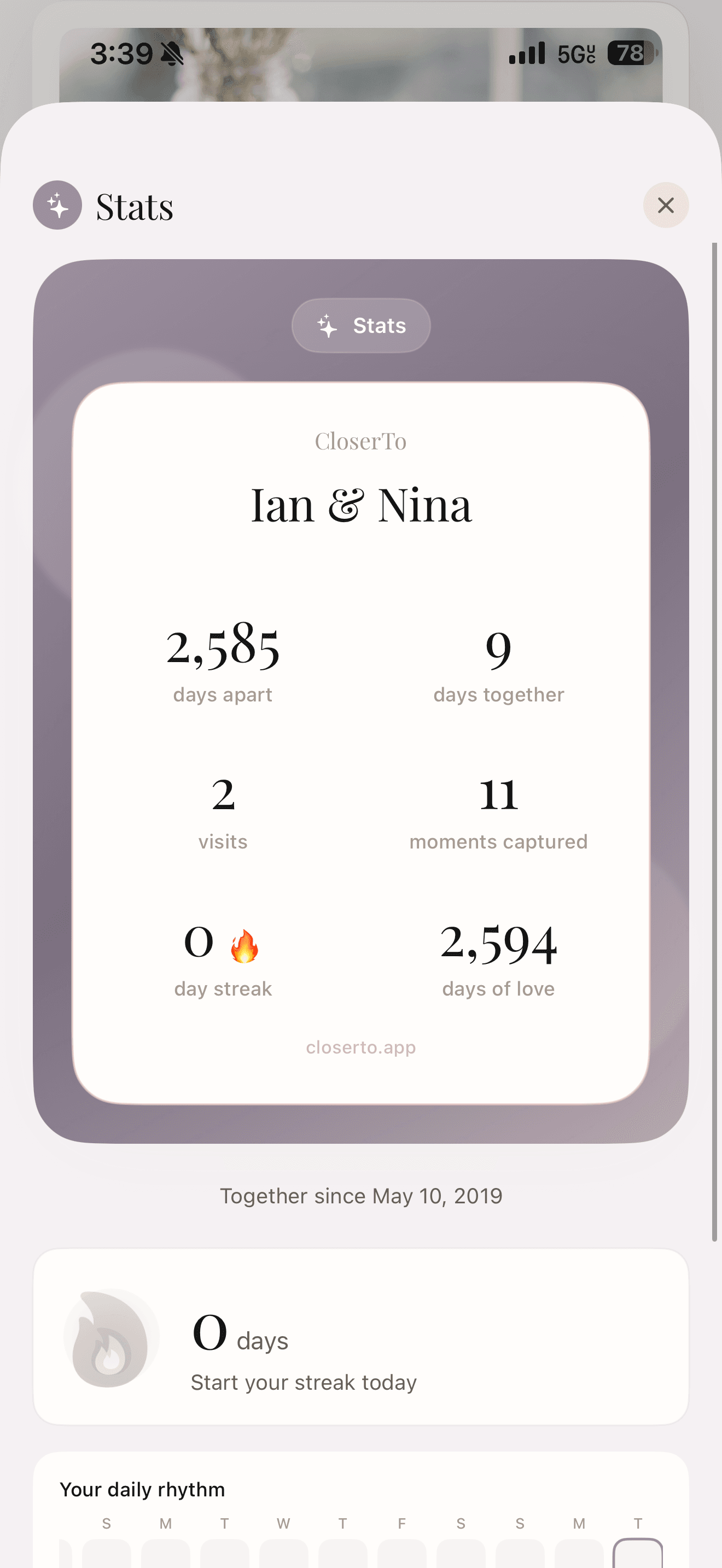
Search for long distance relationship statistics and you’ll find the same handful of numbers repeated everywhere — usually with confident percentages and rarely with a clear source. This guide collects the figures people most often cite, explains what they probably mean, and — just as importantly — flags how much trust each one actually deserves.
The short version: the data is messier than the internet makes it look, but the overall picture is genuinely encouraging. Long-distance relationships are common, they’re not doomed, and the things that predict success are largely within your control. If you’re looking for practical next steps rather than numbers, our guides on how to make a long-distance relationship work and how to survive a long-distance relationship are good companions to this one.
How common are long-distance relationships?
More common than most people assume. Long distance is no longer an unusual situation reserved for military deployments or study-abroad semesters — remote work, online dating, and global mobility have made it an everyday relationship structure.
- Popular relationship surveys frequently estimate that several million US adults describe themselves as being in a long-distance relationship at any given time. Exact counts vary enormously depending on how “long distance” is defined.
- A substantial portion of college students — commonly reported as somewhere around a quarter to a third — say they’ve been in an LDR at some point.
- A notable share of couples report that their relationship started long-distance, rather than becoming long-distance later, partly reflecting how many people now meet online.
The takeaway here is less about the precise figure and more about the reassurance: if you’re doing this, you’re in very large company.
Success and breakup rates
This is the number everyone wants — and the one you should be most skeptical of. You’ll see “success rates” quoted with suspicious precision, but they rarely agree, because they’re measuring different populations over different timeframes.
- A frequently circulated figure suggests that roughly a third to 40% of long-distance relationships end — but this number is repeated far more often than it’s sourced, so treat it as folklore-with-a-grain-of-truth.
- The more robust and widely cited research finding, though, is that LDRs are not dramatically more likely to fail than geographically close relationships. In some comparisons they fare comparably.
- Several summaries note that long-distance couples can report as much (sometimes more) intimacy, trust, and commitment than nearby couples — possibly because distance forces more intentional communication.
In other words: distance itself is not the death sentence the scary statistics imply. The relationships that struggle tend to struggle for reasons that would challenge any couple — mismatched commitment, poor communication, or no shared sense of where things are headed.
The “3–4 month danger period” idea
One of the stickiest pieces of LDR lore is the claim that relationships hit a critical wall a few months in — often pinned at around the three-to-four-month mark — and again later if no reunion is in sight.
- The “3–4 month danger zone” is widely repeated online but lacks strong, traceable sourcing — read it as a rule of thumb, not a law.
- There is a sensible intuition underneath it: the early novelty fades, routines haven’t formed yet, and the gap between excitement and reality can feel sharp around the first few months.
- A second commonly cited risk point is the stretch where a couple has no concrete plan to close the distance — open-ended distance is reported as harder to sustain than distance with a deadline.
If there’s a practical lesson, it’s to expect a dip and prepare for it rather than panic when it arrives. Building small daily rituals and keeping conversation fresh helps — our list of questions to ask in a long-distance relationship is built for exactly those months when small talk runs dry.
Communication patterns
If any single behavior shows up across LDR research summaries, it’s communication — both how much and, crucially, how well.
- Long-distance couples are frequently reported to communicate often and across many channels — texting throughout the day, plus longer voice or video calls.
- Popular surveys often quote a rough average of one or more video or voice calls per day, though this varies hugely by couple and time zone.
- Research summaries tend to emphasize that quality beats quantity: constant low-effort messaging matters less than meaningful, present conversation. More texts don’t automatically mean a stronger bond.
Worth noting: there’s such a thing as over-communicating to fill anxiety. The healthier pattern most sources describe is consistent, intentional contact — a shared rhythm both partners can rely on — rather than a frantic need to be in constant touch.
Visits and closing the distance
Time together in person, and a plan to eventually live in the same place, come up again and again as the variables that matter.
- Popular surveys often cite a rough average distance of a few hundred miles between long-distance partners, and an average of visiting roughly once or twice a month — but both figures swing wildly with cost, distance, and visas.
- The presence of a plan to close the distance is repeatedly described as one of the strongest differentiators between couples who last and couples who drift.
- Reunions and goodbyes carry real emotional weight; the post-visit slump is common enough that it’s worth planning for, as we cover in coping after saying goodbye in a long-distance relationship.
A useful mental reframe: visits aren’t just nice — they appear to be load-bearing. Between them, shared activities help bridge the gap, which is why so many couples lean on long-distance relationship activities and creative date ideas to feel like a couple rather than two people texting.
Military and college long-distance relationships
Two groups are over-represented in LDR conversations — military couples and college students — and their experiences shape a lot of the “common wisdom,” even though their circumstances are quite specific.
- Military relationships face distinctive pressures — deployments, limited contact windows, and uncertainty — yet many endure, often supported by strong routines and a fixed return date to anchor to.
- College LDRs are extremely common, and many are explicitly time-limited (until graduation), which can cut both ways: a clear endpoint helps, but the transition afterward is its own challenge.
- Generalizing from either group to all long-distance couples is risky — a deployment timeline and a semester abroad are not the same as two professionals dating across cities.
What actually predicts success
Strip away the shaky percentages and a consistent, well-supported pattern remains. The things that predict whether a long-distance relationship works are mostly behaviors and conditions, not the mileage between you.
- Mutual commitment. Both partners genuinely choosing the relationship matters more than any external odds.
- Communication quality. Present, honest, emotionally real conversation — not just frequent pings.
- A plan to close the distance. Open-ended distance is harder than distance with a finish line. A rough timeline gives the relationship a direction.
- Trust and security. Couples who manage jealousy and assume good faith tend to fare better than those caught in suspicion loops.
- Shared rituals and time together. Regular visits and small daily habits keep the relationship feeling alive between reunions.
That last point is where small tools help: an app like CloserTo turns those research-backed habits — a daily photo, a visit countdown, a shared journal — into an easy daily ritual so the distance feels smaller between visits.
Distance is rarely what ends a relationship. The absence of a plan, and the slow erosion of intentional connection, do far more damage than miles ever could.
So if you take one thing from the statistics, let it be this: the odds you read online are noisy and often unsourced, but the levers that actually move outcomes — commitment, communication, and a concrete plan to be together — are yours to pull. If you’re ready to put that into practice, start with how to make a long-distance relationship work, and if you’re comparing tools, see our roundup of the best long-distance relationship apps. You can also see how CloserTo handles your time together and your time apart.
Frequently asked questions
- Do long distance relationships work?
- Yes — many do. The widely circulated research consensus is that long-distance relationships are not doomed and don’t break up at dramatically higher rates than geographically close ones. What matters far more than distance is commitment, communication quality, and whether the couple has a realistic plan to eventually close the gap. Treat any single “success rate” figure as directional rather than definitive.
- What percentage of long distance relationships last?
- There’s no single reliable number, and you’ll see figures all over the map depending on who was surveyed and how. Popular surveys often report that a majority of long-distance couples who intend to stay together do, while a frequently quoted (and shakily sourced) figure suggests roughly a third to 40% eventually end. The honest answer: estimates vary widely, so don’t anchor your hopes to one statistic.
- When do most long distance relationships end?
- A commonly repeated idea is that the first few months — often cited as around the three-to-four-month mark — are the hardest, and that the risk rises again when there’s no clear plan to close the distance. These figures are popular but weakly sourced, so read them as a reminder to set expectations and a reunion plan early rather than as a literal countdown.
Keep reading
App Guides
Open When Letters: 25+ Ideas for Long-Distance Couples
Open when letters let you comfort your partner at the exact moment they need it, even when you’re asleep three time zones away. Here’s what to write and when.
App Guides
The Long-Distance Countdown: Why Counting Down to Your Next Visit Works
A countdown gives every goodbye an expiry date. Here’s the psychology behind why it helps, and how to put your reunion countdown right on your lock screen.
App Guides
The Distance Between Us Widget: Put the Miles on Your Lock Screen
The TikTok-famous distance widget, explained: why seeing the miles between you matters, what you need on iPhone, and how to set it up in a couple of minutes.